

Volcanoes National Park in north-western Rwanda is the single most sought-after gorilla trekking and wildlife destination in East and Central Africa for first-time and returning safari visitors. The mountain gorilla (Gorilla beringei beringei) is one of the world's most critically endangered mammals, with a total wild population of approximately 1,000 individuals shared between two geographically separated populations: the Virunga volcanoes (where Volcanoes National Park, Virunga National Park in the DRC, and Mgahinga Gorilla National Park in Uganda share the mountain range) and Bwindi Impenetrable National Park in Uganda.
Rwanda's section of the Virunga range contains 12 habituated gorilla families, and the Volcanoes National Park infrastructure for gorilla trekking is the most developed and most accessible in the three range countries: the Kinigi briefing centre at the park boundary is reached by a sealed tarmac road from Kigali in 2 to 2.5 hours, the trekking guides and trackers are experienced with decades of visitor contact, and the gorilla families are deeply habituated to human observers through successive generations of monitored contact.
This page covers the complete self-drive guide for the Volcanoes gorilla trail: the drive from Kigali, the briefing and trekking procedure, the golden monkey trekking option, the Musanze accommodation zone, and the physical preparation required for the trek.
The Mountain Gorilla Families of Volcanoes National Park
Volcanoes National Park's 12 habituated gorilla families are located on the slopes of six of the Virunga volcanoes within the Rwanda section of the range, at elevations between approximately 2,500 and 3,800 metres above sea level depending on the family's movement within their home range. Each family consists of between 8 and 30 individuals including the dominant silverback (adult male over 12 years old, characterised by the silver-grey saddle of hair across his back), adult females with nursing infants, sub-adult males (blackbacks), juveniles, and younger infants.
The family's social structure is centred on the silverback's leadership, with the silverback making all decisions about the group's movement, food selection, and response to external threats. The habituated families are each assigned a team of UGA tracker-guides who spend every day with the family from dawn, locating the family's position and reporting it to the Kinigi briefing centre by the morning briefing time.
This means that when the 8-visitor trekking group departs after the 7 am briefing, the trackers are already with the gorillas and the guide has GPS coordinates for the family's current location. The family allocated to each visitor's permit group is assigned at the briefing based on factors including the group's physical fitness indication on the permit booking, the family's location on that morning, and a rotation system that distributes visitor contact evenly among the families.
The Susa A group, the largest family in the park at approximately 30 individuals and historically the most famous, is the longest-established research family and includes a very large silverback. The Hirwa family is notable for containing twins. The Ntambara family is associated with particularly productive silverback display encounters.
Each family has its own personality and behavioural tendencies, and guides can describe what to expect from the specific family before the trek begins.
The one-hour observation period that begins when the tracker-guide signals that the family has been reached is governed by Rwanda Development Board regulations that set 8 visitors per family per day as the maximum group size and 60 minutes as the maximum contact time. Both rules are enforced without exception to minimise the cumulative impact on the gorilla family's behaviour, stress level, and disease exposure from human contact.
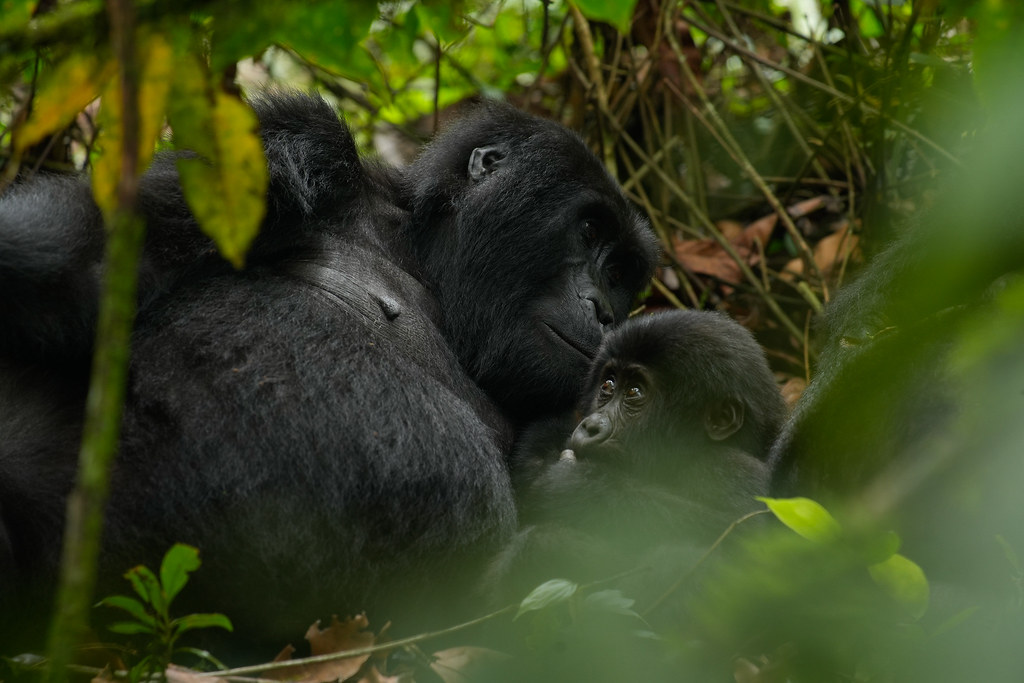
Within the one-hour period, the gorillas move normally — the silverback will typically be resting or feeding in a central position with the family members around him, juveniles playing, mothers nursing infants, sub-adults eating. The visitor group stays in a loose arc around the family at a minimum approach distance of 7 metres, which the RDB guide monitors by standing between the visitors and the gorillas and indicating when to stop or move back.
The gorillas themselves frequently reduce the distance to less than 7 metres by approaching the visitors, particularly juveniles who are curious about the human observers. When a juvenile approaches within touching distance, the guide instructs visitors not to touch the gorilla — an instruction that takes significant composure when an infant gorilla is climbing on your boot.
The silverback may give a warning bluff-charge if a visitor moves suddenly or makes unexpected noise: the correct response is to crouch down and look away calmly, which the guide demonstrates in the briefing. After the hour ends, the guide leads the group back through the forest to the briefing centre or to the vehicle if a different exit route is used.
The Trek: Physical Preparation and What to Bring
The gorilla trek at Volcanoes National Park is a moderately strenuous hiking activity and the appropriate level of physical preparation depends on the location of the specific gorilla family on the day of the trek. The briefing centre is at approximately 2,100 metres altitude and the gorilla families move in terrain between 2,500 and 3,800 metres, meaning the approach walk involves altitude gain in addition to the distance and terrain challenges.
Trekking poles are strongly recommended and are available to borrow at the Kinigi briefing centre at no charge. Waterproof walking boots with ankle support are the most important item of personal equipment: the montane forest floor is always damp and muddy regardless of season, and walking in trail runners or sandals on the steep, root-covered forest floor is both uncomfortable and potentially unsafe.
Long trousers and long-sleeved shirts are recommended for both the cold and the stinging nettles (Urtica dioica) that form dense stands at lower forest elevations and which guides help trekkers navigate through. A lightweight waterproof jacket is important even in the dry season because high-altitude montane forest generates local rain from cloud condensation regardless of the regional weather pattern.
A garden-style hat is more practical than a trail cap because rain comes from below the canopy as well as from above. Water for at least 2 to 3 litres per person for the day is strongly recommended. The family of young children (under 15 years): RDB regulations do not permit visitors under 15 to participate in gorilla trekking.
The physically difficult trek scenario, requiring 4 to 7 hours of steep montane forest walking to reach a family in a distant part of their range, is managed by the guide who will communicate the expected difficulty before departure and will arrange for porters (available at the briefing centre, providing a significant livelihood income to the local community) who carry the visitor's daypack and provide physical support on the steep sections.
Golden Monkey Trekking in Volcanoes National Park
Golden monkey trekking is a second wildlife encounter offered within Volcanoes National Park as a complement to the gorilla trek. The golden monkey (Cercopithecus kandti) is an endemic primate of the Virunga volcano chain, found only in the bamboo zones of the Virunga mountains and in Mgahinga Gorilla National Park in Uganda. The species is distinguished by its extraordinary colouration: a bright orange-gold patch covering the back, flanks, cheeks, and tail, contrasting with the black limbs, crown, and face.
Golden monkeys live in large troops of 30 to 100 individuals and move rapidly through the bamboo forest in a way that makes trekking them a more dynamic, kinetic experience than the relatively placid gorilla observation. The golden monkey trek departs in the afternoon from the Kinigi briefing centre and follows a separate group of trained tracker-guides to the current location of one of two habituated golden monkey troops in the bamboo zone on the lower slopes of Mount Sabyinyo and Mount Bisoke.
The encounter with a large troop moving through the bamboo — cascading orange and black shapes leaping through the vertical bamboo stems in every direction, with the distinctive golden colouration of the adults catching the light at each gap in the canopy — is one of the most visually vibrant primate encounters in East Africa.
The walk to find the troop is typically shorter than the gorilla trek (1 to 2 hours in most cases), and the observation period is 1 hour as with the gorilla trek. A same-day combination of a morning gorilla trek and an afternoon golden monkey trek requires two separate RDB permits but is logistically straightforward for visitors based in Musanze.
See the Rwanda car rental page for vehicle hire from Kigali, the Rwanda practical information page for RDB permit booking details, and the Rwanda 3-parks loop guide for the complete Rwanda circuit including Volcanoes, Nyungwe, and Akagera. To book a vehicle for the Volcanoes gorilla trail, use the book now page.
The Karisoke Research Legacy: Dian Fossey and Mountain Gorilla Science
Volcanoes National Park is inseparable from the story of mountain gorilla research, which began in 1967 when the American primatologist Dian Fossey established the Karisoke Research Centre in a saddle between Mount Karisimbi and Mount Visoke at 3,000 metres altitude in what was then the Parc National des Volcans. Fossey's 18-year programme of habituation, field observation, and advocacy for the gorilla population became the scientific foundation for everything that modern mountain gorilla conservation is built upon: the slow, patient habituation process that eventually allowed researchers to sit among the gorilla family with acceptance rather than flight; the identification of individual gorillas by nose-print patterns (each gorilla's nose has a unique pattern of folds and ridges as individually distinctive as a human fingerprint); the documentation of family social structure and silverback behaviour; and the anti-poaching programme that Fossey ran at considerable personal risk until her murder at Karisoke in 1985. The Karisoke Research Centre continues to operate under the Dian Fossey Gorilla Fund International and remains the world's longest continuously running gorilla research programme, now employing over 100 Rwandan scientists and trackers monitoring multiple habituated families across the Volcanoes range daily.
Visitors who trek to a Volcanoes family are benefiting directly from the 56-year scientific investment made by Fossey and her successors: the habituation that allows a human observer to sit 7 metres from a silverback and watch his family undisturbed for one hour was achieved over multiple years of daily researcher presence that taught successive generations of gorillas that humans are harmless observers.
The Dian Fossey Gorilla Fund campus at Musanze houses a visitor centre and museum that contextualises the gorilla research legacy and is worth a visit before the trekking briefing on the morning of the trek. The tomb of Dian Fossey and the graves of several of her research gorillas are accessible as a guided walk from the Karisoke area for visitors staying multiple nights in the Volcanoes area.