
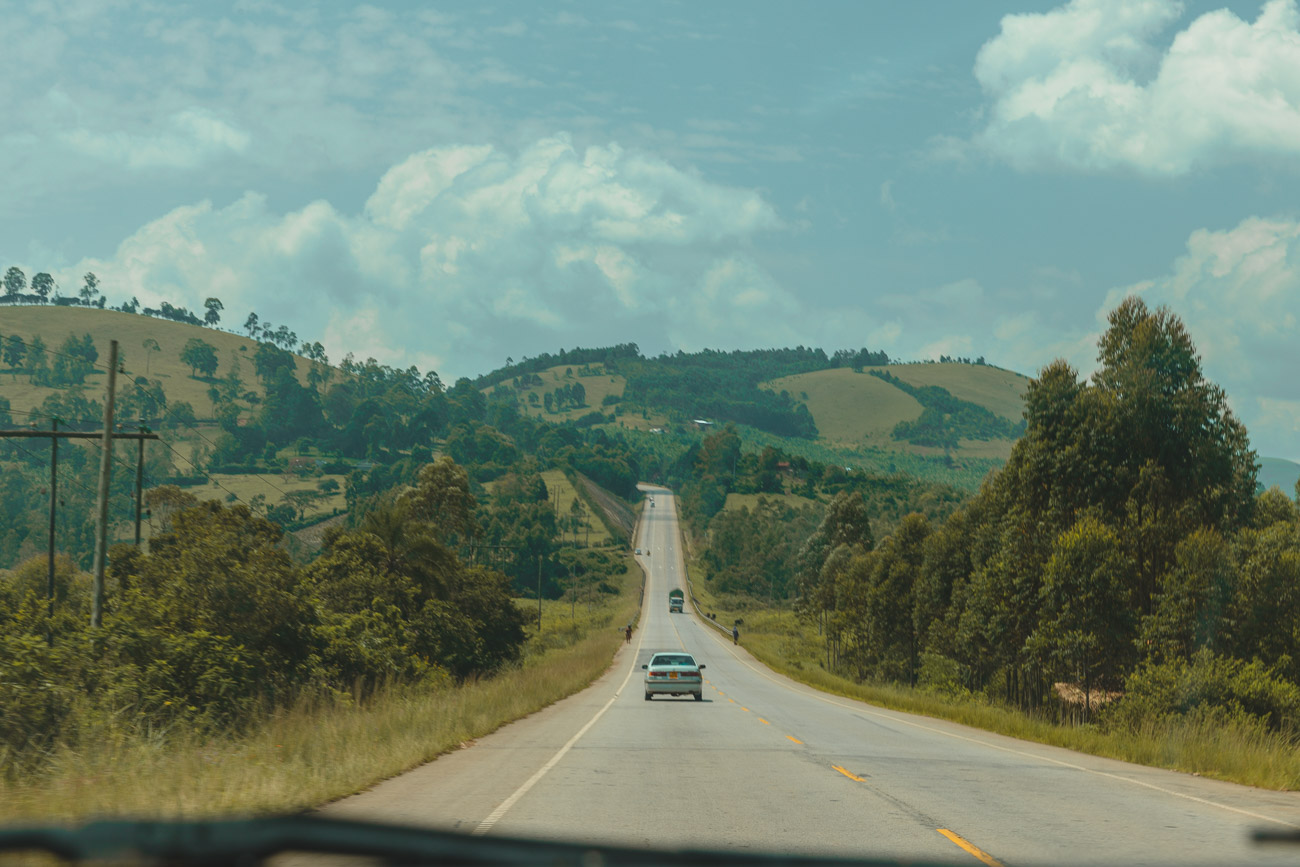
The drive from Kigali to Nyungwe Forest National Park is one of the most scenic road journeys in East Africa. At 227 km on Route Nationale 1 (RN1) through Rwanda's Southern Province, the route takes 4 to 5 hours and passes through terraced hillsides, tea estates, and the edge of the Congo-Nile Divide — the watershed between the Congo River basin and the Nile River basin. This guide covers the exact route, road conditions, stops worth making, and what to know before arriving at Nyungwe's main gates.
Route Overview: Kigali to Nyungwe
The primary route follows RN1 south from Kigali through Butare (Huye) to the northern edge of Nyungwe Forest. From Kigali city centre (Remera junction) to the Uwinka visitor centre on Nyungwe's main road, the total distance is 227 km. The road is paved for its entire length with no significant sections of gravel or dirt. However, this does not mean the road is fast — much of it is winding mountain road through steep hillsides where average speeds drop to 40-50 km/h. A realistic driving time without stops is 4 hours; with stops, 5 to 6 hours.
Stage by Stage: Kigali to Nyungwe
Planning your East Africa self-drive circuit? Car Hire 4x4 Drive provides fully-equipped 4x4 vehicles for Uganda, Kenya, Tanzania, and Rwanda with COMESA insurance and cross-border documentation included. See how the booking process works or send a circuit enquiry for a quote within 24 hours.
Kigali to Butare (Huye): 137 km, Approximately 2 Hours
Leave Kigali via the Nyarutarama-Kicukiro corridor heading south. The KN5 Avenue and its extensions form the main departure route. You'll pass through Kicukiro district and reach the RN1 highway heading south. This section through Rwanda's Eastern and Southern provinces is among the smoothest roads in the country — well-maintained tarmac, clear lane markings, and moderate traffic. Butare, now officially renamed Huye, is Rwanda's university town. The National University of Rwanda is here along with the Rwanda National Museum — one of the best cultural museums in East Africa, worth a 90-minute stop if you have time. The museum covers Rwandan history from the Tutsi cattle kingdoms through colonial period Belgian administration to independence and the 1994 genocide.
Butare to Gikongoro (Nyamagabe): 44 km, Approximately 45 Minutes
Continuing southwest from Butare on RN1, the road climbs steadily into Rwanda's mountain heartland. The scenery changes dramatically — banana plantations give way to terraced hillsides and then the first views of tea estates blanketing the hillsides in deep green. Gikongoro (Nyamagabe town) is the last significant town before Nyungwe Forest and a good place to fuel up. The Total filling station here is the last reliable fuel stop before you enter the forest and there is no fuel available within Nyungwe itself. Fill up completely.
Gikongoro to Uwinka Visitor Centre: 46 km, Approximately 1 Hour
The most spectacular section of the drive begins here. After Gikongoro, RN1 begins climbing through the Gisakura tea estate — thousands of acres of manicured tea plants covering hills that tumble down toward Nyungwe Forest on the right. The estate is operated by Rwanda Mountain Tea (formerly Union Thé du Rwanda) and produces approximately 6,000 tonnes of tea annually for export. The road continues climbing to the Congo-Nile Divide ridge at approximately 2,500 metres above sea level. From the ridge there are views in clear weather west to the Congo Basin and east toward the distant hills of Rwanda's interior. The Uwinka visitor centre is approximately 8 km inside the forest boundary, accessible from the main road. The turn-off is signposted.
Road Conditions: What to Expect
Rwanda maintains its main roads to a consistently high standard. As of 2024, RN1 from Kigali to Nyungwe is entirely paved with no significant potholes or degraded sections. The most challenging aspect is not road quality but road geometry — from Gikongoro onward, the road becomes a series of hairpin bends and steep gradients as it climbs into the forest. Visibility around bends is limited and trucks travel at 15-20 km/h up the steepest sections. Overtaking requires patience.
In the wet season (March-May and October-November), the Nyungwe section of the road becomes slippery and visibility drops due to fog and low cloud which sits on the forest for much of the day. Heavy rain occasionally causes small rockfalls on the steep cuttings immediately west of the ridge. These are quickly cleared but can cause delays of 30-60 minutes. A 4x4 is not strictly necessary on RN1 itself — ordinary saloon cars make this journey regularly. However, if you plan to leave the main road and drive to accommodation within or near the forest, 4x4 high clearance becomes valuable.
Alternative Route: Via Kibuye and Lake Kivu
A longer but even more scenic alternative routes from Kigali via Kibuye (Karongi) on Lake Kivu, then south along the lake to Cyangugu (Rusizi), and finally into Nyungwe from the southern (Cyangugu) gate. This route totals approximately 340 km and takes 7-8 hours, but the Lake Kivu western shoreline road is among the most beautiful drives in Africa. The road is paved but significantly narrower and windier than RN1. This makes more sense as an itinerary loop rather than a direct approach — drive RN1 Kigali-Nyungwe, exit via the Cyangugu gate, and follow Lake Kivu north to Kibuye and back to Kigali, or continue to Gisenyi (Rubavu) near Volcanoes NP for a complete southwestern Rwanda loop.
Stops Worth Making Along the Way
Butare (Huye) — Rwanda National Museum
Located just off the main road in Butare, the Rwanda National Museum (opening hours 08:00-17:30 daily, entry approximately RWF 5,000 / USD $4.50) has 6 permanent galleries covering Rwandan prehistory, traditional culture, royal court life, German and Belgian colonial history, and the 1994 genocide. The ethnographic collection includes traditional drums, royal cattle bells, and woven baskets. Allow 90 minutes. The museum café serves coffee and local food.
Gisakura Tea Estate Viewpoints
Several pullouts on RN1 within the Gisakura tea estate offer sweeping views across the tea-planted hills. There are no formal viewpoints but the road shoulders are wide enough to stop safely. Photography here in morning light (before 09:00) or late afternoon (after 16:00) is exceptional. The Gisakura Tea Factory (near the Gisakura Guest House turn-off) sometimes accepts visitors for tea factory tours — ask at the Nyungwe Forest Lodge reception if visiting during the picking and processing season.
Congo-Nile Divide Viewpoint
The roadside sign marking the Congo-Nile Divide ridge sits at approximately 2,500m elevation. This is where rainwater either flows west toward the Congo River and ultimately the Atlantic Ocean, or east toward the Kagera River, Lake Victoria, and the Nile. There is a small car park. In clear weather (most common in dry season), the view is panoramic. Mornings are often clearer than afternoons. A lightweight fleece or jacket is useful here — the temperature drops noticeably at altitude after the lower-elevation heat.
Nyungwe Forest: What to Do Once You Arrive
Nyungwe Forest National Park covers 1,020 sq km of montane rainforest on the Congo-Nile Divide, making it one of the largest intact montane forests in Africa. The main activities requiring advance booking are chimpanzee trekking (USD $150 per person), colobus monkey trekking (USD $100 per person), canopy walkway (USD $50 per person), and guided bird walks (USD $30 per person). All bookings through Rwanda Development Board at rdb.rw.
Nyungwe harbours 13 primate species including chimpanzees, L'Hoest's monkey, Ruwenzori colobus (troops up to 400 individuals), grey-cheeked mangabey, and olive baboon. Bird diversity stands at 310 recorded species with 27 Albertine Rift endemics including the Ruwenzori turaco (easily seen on the canopy walkway trail), Grauer's rush warbler, and the Albertine owlet. The forest receives over 2,000mm of rainfall annually — pack waterproof gear regardless of season.
Accommodation Near Nyungwe
Options range from Rwanda's most expensive eco-lodge to a basic guesthouse in Gisakura village:
- One&Only Nyungwe House (formerly Nyungwe Forest Lodge): USD $500-900/night, within the tea estate adjacent to the forest, direct trail access, spa and pool.
- Gisakura Guest House: USD $50-80/night, Rwanda Development Board operated, functional accommodation directly at the park boundary with a canteen and bar.
- Nyungwe Top View Hill Hotel: USD $35-50/night, in Gisakura village, basic rooms, restaurant.
- Cyangugu (Rusizi) accommodation: 54 km from Uwinka via the southern park exit road. Hotel Ituze (USD $40/night), Rusizi Hotel (USD $30/night) for budget travellers willing to commute into the park each morning.
Fuel, Phone Signal and Practical Tips
Fuel is available in Kigali, Butare, and Gikongoro. There is no fuel station within the forest or between Gikongoro and Cyangugu on the southern approach. Fill up completely in Gikongoro before entering. MTN Rwanda and Airtel Rwanda have signal on the main road through the forest but signal is weak or absent 100m from the main road into the forest. Download offline maps (maps.me or OsmAnd) before departing Kigali. Park headquarters at Uwinka has WiFi. The drive from Kigali makes an easy day-trip to Nyungwe with a 06:00 departure getting you to Uwinka by 10:00 in time for the morning canopy walkway visit — though overnight is better for chimpanzee trekking which starts at 08:00 and requires being at the Uwinka trailhead by 07:30.
A 4x4 is essential for circuits that include the Ngorongoro Crater descent (which requires centre differential lock), the Bwindi Impenetrable Forest approach road in wet season, or Kidepo Valley National Park. For circuits that stay on sealed national highways and well-maintained murram roads in dry season a capable 2WD can manage — but the Toyota Land Cruiser V8 GX with full 4WD and diff lock is always the safest and most reliable choice for any East Africa self-drive circuit.
You need a valid driving licence (plus an International Driving Permit if your licence is not in English), the COMESA Yellow Card insurance certificate, a cross-border authority letter from the vehicle owner for each transit country, and the vehicle registration document. Car Hire 4x4 Drive prepares all cross-border documentation for the specific countries on your circuit as part of the standard hire process — no separate arrangement needed.
Yes. Most East Africa self-drive circuits do not require technical off-road skills — the majority of driving is on sealed national highways or well-maintained murram park roads. The vehicle handover at collection includes a full demonstration of the 4WD system. If your circuit includes genuinely technical sections such as the Ngorongoro Crater descent or Bwindi wet-season approach, a car with driver can be arranged for those sections if you have no prior 4WD experience.
Book 4 to 8 weeks in advance for standard circuits. For July to August peak season and December to January, book 3 to 4 months ahead. If your circuit includes gorilla trekking, Uganda permits via UWA should be booked 2 to 6 months ahead and Rwanda permits via the RDB 3 to 9 months ahead — the vehicle booking should align with confirmed permit dates. See the How It Works page for the complete booking process and deposit schedule.
The Toyota Land Cruiser V8 GX is the standard recommendation for any circuit covering two or more countries, or any circuit including Tanzania (Ngorongoro requires mandatory 4WD with diff lock) or Uganda's challenging approach roads. For Kenya-only or Rwanda-only dry-season circuits the Land Cruiser Prado is a cost-effective alternative. For groups of 6 or more passengers, the Toyota Hiace 9-seater safari van with pop-up roof is the most cost-effective per-person option.